

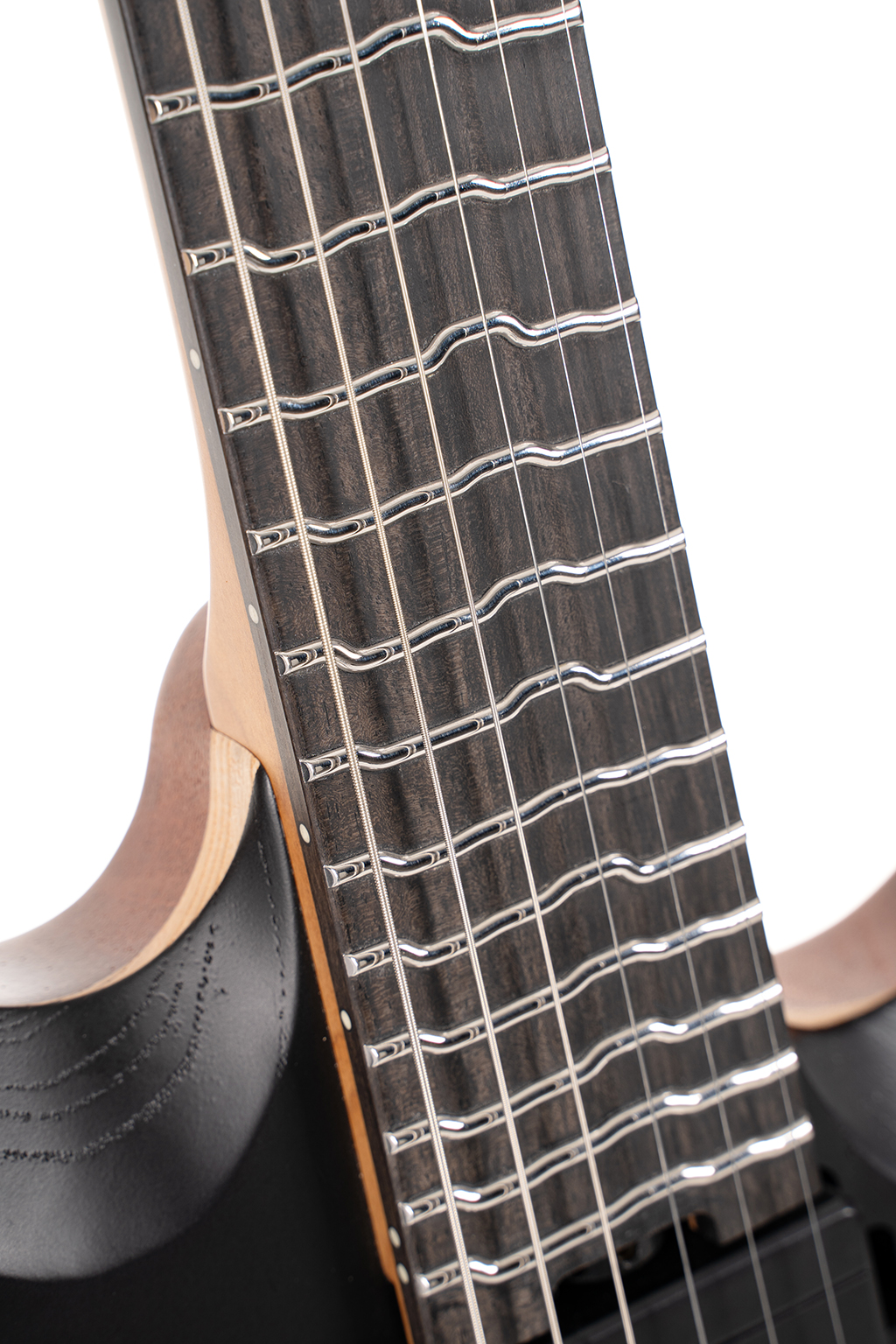
There is a rather fascinating paradox in the guitar world.
Some of the world’s most celebrated guitarists love playing instruments equipped with True Temperament. They use them during rehearsals and in recording studios. They appreciate the intonation, the precision, and the ability to finally hear chords and notes ring with exceptional accuracy across the entire fretboard. Most importantly, it enhances playability, giving guitarists greater freedom to focus on their performance and musical expression.
But when those same guitarists step onto the world’s biggest stages, something rather strange sometimes happens. Suddenly, traditional straight frets are back.
Why?
The answer rarely has anything to do with music. It has more to do with marketing, brand strategies, and assumptions about what the mass guitar market wants.
Some major guitar manufacturers remain cautious about True Temperament. Despite decades of innovation in electronics, materials, and manufacturing, the guitar industry remains remarkably conservative when it comes to the fretboard itself. The thinking seems to be that squiggly frets are too different, that they might confuse consumers, or that they could somehow interfere with sales to the broader market.
And yes, we understand that large companies need to think commercially. We also understand that artists with major endorsement agreements don’t always have complete freedom to choose which instruments they bring on stage. We’ve even had artists personally explain and apologize to us for the situation.
We appreciate that. But really, it shouldn’t be necessary.
Because why should one option exclude the other?
Imagine if the major guitar brands simply offered both. Traditional straight frets for those who prefer them, and True Temperament for those who want the benefits of significantly improved intonation.
Give your customers the freedom to choose. Give them the opportunity to experience what improved intonation can bring to their music.
The audience would have the opportunity to see, hear, and perhaps most importantly, discover the difference. And ultimately, consumers could make their own choice.
Isn’t that exactly how technological progress should work?
True Temperament isn’t about making guitars look different. Our squiggly frets are the result of decades of research, development, and uncompromising dedication by our founder and inventor, Anders Thidell.
With his patented Thidell Formula 1 and the concept of Dynamic Intonation, we have addressed a fundamental problem that guitarists have lived with for generations: the inherent intonation compromises of a traditionally fretted guitar.
Dynamic Intonation takes into account how each individual guitar string actually behaves when played, compensating for its physical characteristics at each fret position rather than relying solely on theoretical mathematical divisions of the scale. The result is dramatically improved intonation across the entire fretboard, allowing notes and chords to sound more accurate, balanced, and harmonically rich.
We haven’t changed the guitar simply for the sake of change. We’ve improved something fundamental.
And this is hardly a new problem.
Throughout history, musicians have explored different temperaments in pursuit of greater harmonic accuracy and musical expression. As equal temperament became the dominant standard, much of this exploration gradually faded into the background. But the fundamental challenges of guitar intonation never disappeared.
As far back as the 16th century, instrument makers were experimenting with movable frets to improve intonation. One fascinating example from that era is a Portuguese guitar built by Belchior Dias in Lisbon in 1581. Instruments of the period used movable gut frets that allowed adjustments to pitch, but such solutions were hardly a practical, permanent answer for the modern guitar.
Almost 450 years later, we are still dealing with the same fundamental challenge. The difference is that Anders Thidell developed a practical and reliable solution using fixed, individually compensated frets and Thidell Formula 1.
It is actually rather remarkable that solving a problem recognized during the Renaissance can still be considered controversial today.
And yet, progress is happening.
More and more guitarists are discovering the difference. More luthiers and manufacturers are beginning to recognize the possibilities. True Temperament is already being used on everything from electric guitars to acoustic instruments, and interest extends far beyond any particular musical genre.
That is why we are not particularly worried.
It might take five years. It might take ten. Perhaps even longer. The guitar industry has its traditions, and change takes time, especially when it challenges something that has looked essentially the same for centuries.
But we are convinced that True Temperament, Dynamic Intonation, and Thidell Formula 1 will eventually be recognized as a natural standard, a technology that no serious guitar manufacturer can afford to ignore.
Not because we say so.
But because guitarists themselves, when given the freedom to choose, will ultimately decide.
The future doesn’t need straight frets. It needs open minds.